

Middletown, the latest SFUAD Performing Arts Department production, opens with Curtis Williams’ Public Speaker waxing philosophic about the nature of small towns. It’s a fun digression that captures the high energy and inherent sadness of the mostly plot-less but emotionally poignant show that follows. The play has an ensemble cast, but there are a few characters given the most time to shine, including: Mathew Eldridge’s John Dodge; Porscha Shaw’s Mary Swanson; Michael Phillip Thomas’s Cop; and Jade Lewis’s Mechanic. Eldridge and Shaw did a phenomenal job carrying the emotional weight for much of the play. Due to the structure of the play, many of the actors had the difficult job of taking what could easily be one-note characters and adding pathos. It seems lazy to make such a blanket statement, but the whole cast was really up to the challenge. Not every joke landed, and not every character left the same impression, but the batting average is so high, it is easy to brush off the shortcomings. Maia Rychlik’s Librarian and Yusef Seevers’s Doctor, in particular, breathed such life into simple characters that leave one combing through all of their dialogue for hidden meaning long after you leave Greer Garson Theatre. The two scenes that stood out most were the scene in space and Lewis’s scene with Tallis Geohegan-Freifeld’s Doctor. The scene in space, featuring Matt McMillan and Robert Henkel Jr. is nestled towards the end of Act One. The scene is by far the most removed from the plot, but is the first point where the themes are front and center. McMillan and Henkel Jr.’s subtle performance prevents the message from being overbearing. Chelsea Kuehnel’s sets are also a delight in their simplicity, giving the space scene a magical feel and the dusty...
Dinner Talk
posted by Amanda Tyler
SFUAD students answer the common icebreaker: “If you could have dinner with any person, who would it be?” and reveal what they would like to discuss with their picks. Answers range in variety from the predictable celebrity to an elusive family...
From São Paulo to Santa Fe
posted by Sandra Schonenstein
Sandra Schonenstein and Chris Stahelin continue with their profiles of international students. This week: Brazil. Both Thiago Ricco Dias (by Schonenstein) and Victor Rodrigues (by Stahelin) are from São Paulo, Brazil. Originally an advertising major, Dias is studying graphic design at SFUAD, and has sports photography in his mind for the future. Rodrigues f is a film major, who also does a bit of photography. He greeted Santa Fe saying, “Hi Santa Fe, my name is Victor and I love it here” in...

Let the Games Begin
posted by Maria Costasnovo
“I’m sorry about the mess in my room,” says Sydney Latchaw while she opens the door. But it’s clear from her room how organized Latchaw is: her books are perfectly arranged, the kitchen is so clean you can see your reflection and the bed is perfectly made. Latchaw also is using her organizational skills to pull together ‘The Hunger Games’ for all the residents of the campus, an idea she’s had for two years. “I thought it was going to be this big,” she says, indicating her initial belief that organizing the event wouldn’t be too overwhelming, “but I think that as soon as I started to write everything down, it was like ‘oh this is all a hard work, we’re going to need all the RAs on board.'” The Hunger Games is a movie based on a novel written by Suzanne Collins. In the story, an apocalyptic event destroys civilization and a new nation called Panem, divided in 12 districts, is established in North America. Each year, two young representatives from every district are selected to participate in The Hunger Games, a televised fight to the death. “I know this last time the movie came out there was a huge group of students that got really jazzed about it,” Latchaw says, “So a friend and I were like ‘well, we could do Hunger Games on campus.’ And so we came up with this whole system of challenges and stuff like that to mentally test the participants.” Even though, according to Latchaw, the organization of the game is hard, she has almost everything planned out. To start, she will set out boxes in the dorms’ hallways, in which students can enter their names. “And then at the Vampire Ball, which is going to be another...

Coming Attractions
posted by Charlotte Martinez
The Screen Presents: Oct. 11- 17 Music Majors, I have two words for you: Muscle Shoals! The true story of the small town with a big sound credits Tennessee’s spiritual “Singing River” as the birthplace of America’s most celebrated music. From the FAME Studios of Rick Hall, blacks and whites work together in the heat of Alabama’s racial hostility to create what is called the “Muscle Shoals sound.” To attest to Shoal’s reputation are artists Greg Allman, Bono, Clarence Carter, Mick Jagger, Etta James, Alicia Keys, Keith Richards, and Percy Sledge. In a documentary “propelled by gorgeous music and rich anecdotes,” David Gritten of The Telegraph calls the story of Shoals “joyous, uplifting and as funky as the music at its heart.” Opens this Friday. Intro with co-producer Raji Mandelkorn opening night, Friday Oct. 11, 7pm. Tickets on sale at https://www.vendini.com/ticket-software.html?w=14f6950e134574f6487b9ca0ea89aabf&t=tix Saturday, Oct. 12 7pm, The Jewish Film Festival presents Defiant Requiem From late 1943 to June of 1944 at the Terezín Concentration Camp, imprisoned Czech conductor Rafael Schächter led a chorus of his fellow Jewish prisoners — most of them doomed to the gas chambers at Auschwitz — in 16 performances of Verdi’s Requiem, including once before the very Nazis who had condemned them to death. With only a single musical score, this group of 150 fated Jewish prisoners would learn and sing Verdi’s momentous work. Over 60 years later Conductor Murry Sidlin, accompanied by a handful of survivors, returned to Terezin to conduct a memorial concert of the Requiem. The story of Terezín (aka Theresienstadt), the Requiem, and of Conductor Murry Sidlin’s return to conduct a memorial concert is eloquently told in director Doug Shultz’s powerful new documentary Defiant Requiem. One of the most complex and demanding of chorale works, Verdi’s 1874...

A Better Story
posted by Arianna Sullivan
For Santa Fe-based documentary photographer David Scheinbaum, art is at its finest when related to social issues. “To bring attention to some of the ills and inconsistencies of society,” says Scheinbaum, “is to use art at a higher level.” Scheinbaum’s newest book, Hip-Hop: Portraits of an Urban Hymn, is a collection of photographs of hip hop artists that sheds light on the “ills and inconsistencies” of society’s general view of hip hop culture. Scheinbaum’s book depicts a community that, contrary to its reputation, connects art to social issues. Scheinbaum first saw the discrepancy between mainstream media’s representation of hip hop culture and the actual work coming from hip hop artists 13 years ago when he drove his 12-year-old son and several of his friends to a hip hop concert at Albuquerque’s Sunshine Theater. Scheinbaum stuck around to see if the scene was appropriate for the kids and was struck by the positive atmosphere of the concert. He began to attend more shows, bringing his camera with him to try to capture the socially responsible, relevant and dynamic scene he witnessed again and again. As Scheinbaum grew closer (both literally and figuratively—he eventually gained access to the stage and backstage areas for better shooting angles) to the hip hop performers who visited Albuquerque, he realized that not only is their art form inextricable from social issues, it is much more complex and involved than most outsiders realize. Hip hop, like most creative cultures that begin at the fringe of society, arose out of a necessity to express the inequality being experienced by the marginalized. In an essay in Scheinbaum’s book, Gaye Theresa Johnson, an associate professor of black studies at UC Santa Barbara, explains that the art form originated as and still is “a serious...

Mix it Up
posted by Tim Kassiotis
Before you attend the October MIX, here are some take-aways from the last one. Taking place the third Thursday of almost every month, Santa Fe Mix is a social event full of mingling, splashy cocktails, art, and making connections. The mission of Santa Fe Mixes is to bring together all the “young” people in Santa Fe and provide a space for people to network, share ideas, develop business strategies, or collaborate on art. At this point you’re probably thinking “Really? A social gathering in Santa Fe? I’d rather go to a party at the nursing home”. Don’t be so quick to judge. The Sept. 19 Mix was full of emphatic conversation, loud music and splashy drinks that brought out the socialite in a city full of introverts. Sticky MIX was held at Matthew Gray’s studio at 821 W San Mateo Road. It’s that giant loft studio attached to Chocolate Maven. The name was inspired by Mathew’s work on display, which consisted of six sculptures made from hard cast candy and four large format photographs of other sugar creations. Each sculpture or photograph was lit with a flood light, presenting the vibrant sugar coated works with an ominous tone. Dozens of mixers gathered around the food table, eagerly waiting for the next full plate of refreshments. Chocolate Maven provided the catering; making sure every one had a bite of one of their exquisite finger sandwiches, cookies, or signature chocolates. Downstairs Dj Aztec Sol spun records and dropped beats, making sure that the Mix was elevated from a normal gallery opening to party status. One of the main purposes of a Santa Fe Mix is to collect data. This is done primarily with surveys handed out at the door. Although not mandatory to get in, filling...

2013 Launch of Shoot the Stars
posted by Charlotte Martinez
Tuesday, Sept 24, Film School Chairman Chris Eyre officially announced this year’s Shoot the Stars scripts, directors and producers. Two teams, two stars, two films! “These were extremely difficult selections,” Eyre writes in his email to film students, some of whom were disappointed not to see their names on the list of directors and producers. “We have so many talented students here at The Film School,” Eyre continues, “Hollywood, of course, is a place where ‘no’ is said a lot more than ‘yes.’” Last year, Eyre initiated the first of the Shoot the Stars projects, announcing that every year in November the Film School would hire two well-established “star” actors to work under two student-assembled film crews. The product would be two short films, produced entirely by the Santa Fe University of Art and Design Film School. For seven students, the announcement of scripts, directors and producers was taken with relief and great anticipation. “I’m dying to be a director,” says Joshua James, the official director for Baxter Smith’s screenplay, Mister Stapleton. When he was called for his interview, James explains, he didn’t know what to expect. “The email said you had to have a pitch ready…but when I got in there, it wasn’t so much a pitch as it was a conversation.” Similarly, Bonnie Burchfield, the Producer for Mister Stapleton, describes the interview with Assistant Chair Paula Amanda and Hank Rogerson, film production instructor, as a conversation between acquaintances.“It was very calm,” Burchfield says. “I didn’t feel like I was going into a tense situation. Hank has such a warm vibe about him anyway, he’s so soothing that it made me feel really confident.” Hank Rogerson, in charge of Shoot the Stars’ production team, explains that in selecting candidates for director and producer “faculty goes by class experience,… applications, GPA, and year. And then,” Rogerson adds, “it comes down to how they present themselves in the interview, through preparation, presentation and vision.” As upper classmen, both James and Burchfield share the benefit of having worked with the Film School staff. In anticipation of Shoot the Stars 2013, they’ve directed and produced their own students films. “What made the final selections stand out,” Rogerson says, “was how much they presented a whole package—from vision for the projects to track record in the department.” For those unfamiliar with the tasks of a film producer, Burchfield considers it the job suited for “real problem solvers.” “They’re there to do the business end,” she says. “The end that the director doesn’t want to think about.” In charge of budget for pre-production, production and post production, Burchfield says, “they stay with it through to the end, into marketing, into the film circuit.” The problem solving, Burchfield describes, comes in when the director’s vision does not match the boundaries of the budget. “They have to provide other options,” Burchfield says, “that stay within the creative vision of the director.” Speaking of directors, Joshua James, a senior of the Film School, says he had been thinking of signing up for Shoot the Stars since January. In anticipation, James directed and produced a student film in the Spring called Nightmares and Daydreams in hopes the addition to his resume would give him a leg up. With plenty of film directing under his belt, James says his theater background, five years acting and directing plays in high school, also came up during his interview. “Mister Stapleton is written a lot like a play,” James says. “Baxter described it as kind of a gloried sketch that can be performed live if it weren’t for particular elements. When Chris [Eyre] told me that I got the position, he told me that my theater experience was a big reason for it. He thought I’d be comfortable with the actors and I’d have a good understanding of how to communicate with them.” Terry Borst, screenwriting instructor for the Film School and...
Eyre in the Family
posted by Nicholas Beckman
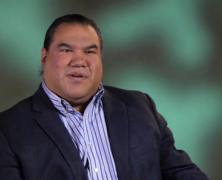
This article is part of a series of stories covering SFUAD’s new scholarship opportunity, The Robert Redford/Milagro Initiative scholarship, and the key players who have been vital to its success. “It’s all about networking,” Chris Eyre said, reflecting intently on his past 20 years in the film industry. Eyre, chairman of SFUAD’s Film School, spoke with such emphasis and humble pride about the path he has taken since attending NYU’s Master’s Program, that it appeared as if in this particular moment he had just put it all together, making sense of the incredible journey. Granted, as someone who had the life-changing opportunity to have his own creations workshopped and mentored by some of the movie-businesses’ finest as part of the Sundance Institute’s Director’s Lab, Eyre is no stranger to the intense and often unnerving world of independent film. “Ride the wave,” Eyre says. “That’s all you can do.” The wave Eyre refers to is the success into which he so modestly stepped when he met Robert Redford at the Sundance Institute. Eyre describes his first meeting with Redford as both daunting and, quite frankly, a little awkward (for Eyre, that is). Redford was reviewing the piece Eyre had written and created during his stay at the Sundance Labs. Eyre recalls Redford’s criticism as constructive and founded in years of knowledge of the craft, but there was only one problem: Eyre’s film was already finished. There was no time or resources to go back, re-shoot and fine-tune his work into a Redford-approved masterpiece. Eyre best described his reaction to this critique with a giant gulping “Huh?!” However, after spending time with Redford and learning more about the evolution of a filmmaker’s skill-set, Eyre found that those critiques were not calls-to-action, but solid advice for the...

All ‘Bad’ Things Must End
posted by Nick Martinez
“Guess I got what I deserved,” sang Pete Ham from Badfinger’s 1971 single “Baby Blue,” over Breaking Bad’s final moments. And despite Walter White’s final string of mini-victories, his death was the only proper conclusion. “Felina” opens back in New Hampshire with Walt trying to steal a parked car. Police lights shine from behind and for the first time in memory Walt prays for the chance to get back to the ABQ. The police leave and through divine intervention the car keys slip from the visor. Walt starts the car, Marty Robbins’s “El Paso” blares from the stereo, and for the last time, audiences hear the opening theme. Fans were worried leading up to the finale, having felt wronged by show-runners before (Damon Lindelof’s Lost, David Chase’s The Sopranos), but having seen the episode twice now, I feel that there is only one word to describe Breaking Bad’s finale: perfect. Vince Gilligan, and his team of merry writers, were able to produce a finale that was both thematically and structurally pleasing. Some have argued that storylines were wrapped up too neatly, but I would argue in the age of cut to blacks, and lumberjacks, true closure is refreshing. The standout moment of this episode has to be Walt’s scene with Skyler. Set in her new dingy apartment, Skyler tells Walt he has five minutes to talk. Walt gives Skyler the GPS coordinates that will lead the DEA to Hank and Gomez, hoping that the coordinates will be a good bargaining chip to get her off the hook. He also starts to tell her why he did what he did. “Stop, if I have to hear one more time that you did this for your family-” says Skyler. “I did it for me,” Walt says to a stunned Skyler. “I like it. I was good at it. And, I was really… I was alive.” One of Walt’s defining characteristics throughout the show was his inability to face the truth. To justify all of his actions, regardless of their moral depravity. But in the moment where he finally tells the truth, for Skyler, as well as the audience, there is relief. In no way was Walt redeemed; he’s caused so much pain and destruction to those around him to ever be redeemed, but it completes the tragic series of events. The hero finally recognized he was the villain. There was plenty of relief this episode for fans. Walt blackmails Gretchen and Elliot into leaving Walt’s $10 million into a trust for Jr.; with the help of Badger and Skinny Pete (“I don’t know, this all seems kind of shady, like, morality wise.”); Walt uses Chekov’s Ricin against the ever-deserving Lydia; Walt’s rigged M60 takes down Uncle Jack’s (Michael Bowen) entire Neo-Nazi crew; Jesse strangles Todd with his own chains; and Walt kills Uncle Jack in a masterfully similar way that Uncle Jack killed Hank in Ozymandias. Jesse’s refusal to shoot Walt in the end was a fitting conclusion to his arc. He finally refused to do Mr. White’s bidding. The final shot of his screaming and crying, blazing out of the Neo-Nazi compound, was the perfect mixture of happiness, shock, anger and relief. As a long time fan, I was happy that there was no trip to Belize. In the end, Breaking Bad is Walt’s story. His casual stroll through the Neo-Nazi meth lab, lovingly caressing his tools, while police sirens blared, was a fitting end to his life. He died with what he loved. I’m a fan of television. My throat dried as Stringer died, my heart skipped a beat when Tony cut to black. But, without a single doubt in my mind, Breaking Bad is the greatest television series of all...

Coming Attractions
posted by Charlotte Martinez
The Screen Presents: Oct. 4 – 10 Short Term 12, Most Recommended by Students! Winner of best actress and director in the Locarno Film Festival, Short Term 12 has been raved by SFUAD students as a must see! An excellent example of Independent filmmaking: great actors, great plot, and it guarantees moments of tears. Richard Roeper from Chicago Sun-Times calls it “one of the best movies of the year.” La Camioneta, the Journey of One American School Bus La Camioneta follows the migration of a US school bus to the city of Guatemala, where it is revived and used by the vast majority of workers. J. Hoberman of ARTINFO.com calls it “a poetic, even dream, film that ultimately conveys the mystical sense of a transmigrated (mechanical) soul.” Opens this Friday. You Will Be My Son, the amazing 35mm print is still showing! Come see some awesome film projection. The Screen’s Fall Performance schedule is up. These high definition Operas and Bellets come to you from theaters like the Bolshoi Theater in Moscow, the Royal Opera House in London, the Teatro Antico di Taormina in Italy, La Scala in Milan and Sydney Harbour in Austrailia. Visit http://thescreensf.com/streaming-opera-in-theaters#.Uk2xTmRVR9T for performances and performance times. Visit thescreensf.com for movie times 505.473.6494 1600 St. Michael’s Drive Santa Fe, NM 87505 thescreensf.com...
Navigable Obstacles
posted by Brandon Ghigliotty
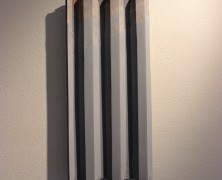
Tom Miller’s first exhibition at Zane Bennett Contemporary Art, Walling: Containing Architecture challenges the difficulties imposed by framing and claiming space, as well the implications of division. Perspective shifts from one side of the barrier to the other: On one side, hope and possibility; and on the other, denial and entropy. “Long Wall with Fix,” a floor sculpture that dominates the entrance of Zane Bennett Contemporary Art, bisects the cracked, striated concrete floor. Gallery goers navigated the wall in their own way, with many simply reaching over to shake Miller’s hand, rather than work their way around. This is an intended consequence and a result of Miller’s desire to thematically enact walling and distance through a barrier installation. Throughout the night, people seemed to gather on the side of the wall that faced the entrance. Its white face interrupted by raw plywood patchwork near the top. The front starkly contrasts the rear, its naval-gray neutral hue and tank trap trusses evident and imposing. One side stands clean, welcoming and projecting perfection, while the other feels militarized and built to task. The same materials—plywood, resin and paint—crafted for different evocative purposes. The work weaves through the gallery. A narrow stretch of hallway holds work that lies vertical in opposition to the long horizontal hall. Just before the path turns the hallway, “New Standard” appears. The perspective of the painting denotes two symmetrical swathes pulling away from the center, and each other, threatening to creep from its canvas and wrap around its privileged space. “Small Tower“ marks the beginning of the hall, both obstacle and observation tower, with a peg leg repair that replaces one of the four feet it rested upon. In the hall, a piece known as “Slice“ beckons observers closer. “Slice’s” top shows marred, exposed wood—forgotten or...

Soccer Unites
posted by Maria Costasnovo
“A child raised practicing sports is raised with values that nothing else can give them: companionship, solidarity and, most importantly, being able to be part of a team,” says Pablo Byrne, a senior from Mexico, and one of the students who meets every Tuesday at the Driscoll Fitness Center to play soccer. Last semester, a group of SFUAD students joined in the Boys and Girls Club of Santa Fe’s soccer league. Now, students—along with players from other schools and the Santa Fe community—transform the court at DFC to a multicultural meeting place each week. “One of the best things about soccer is the union it makes between people. We are from different countries. We are here, together, doing the same thing, at the same time and we all enjoy doing it, which is incredible,” says Victor Rodrigues from Brazil. And soccer, some players say, is the perfect sport to bring people together. “Sometimes, people in my country are really separated because of political reasons,” says Patrick Roessner of Mexico. “But when the World Cup comes, all of Mexico is united, supporting the same team and being happy or sad for the same reason: the victory or the defeat.” But even when people enjoy playing soccer, there are contrary opinions about this phenomenon called soccer: “When your team is playing, it seems like it is the only important thing in the world,” says César Pérez of Mexico, who enjoys the DFC game, but doesn’t have the same level of fanaticism for the game as a whole. “In my country, there are lots of problems in the politics, people being killed in the streets, and poverty. However, none of these things matter when it comes to soccer: people forget about these things and they are happy if...

Olympics A Success
posted by Nick Martinez
On Sept. 21, SFUAD Student Life hosted the first-ever student Olympics. Students participated in a variety of events, including: water balloon toss, volleyball, inflatable obstacle course, basketball, dodge ball, team three-legged race, Sumo wrestling and, of course, a costume contest. Though certainly not a clinic on athletic ability, SFUAD students were up for a fun, sun-soaked day of competition. “I would say that the events were a good mix of fun, and competitive,” said Jakob Anderson, team leader of the 1st place Team Jakob. “It depended on the event, I guess. The Sumo thing got kind of rough.” Student life member Ramiro Leal agreed with Anderson on the event’s success. “This year’s event was most definitely a success,” said Leal. “We always have successful events. That’s not to be taken in a cocky way, but what I meant to say is that even though we might not reach our goal for the specific event, we strive for success within the group, success for learning.” At the end of the day the final count left Team Jakob in first, Super RAs in second, and the Ki-Ki Maow Maows in third. “After a good team effort, it was nice to take home the gold,” said Anderson. “And beating the RAs was of course a big bonus.” Leal was so happy with how the Olympics came together and he hopes that they can bring the event back for the spring semester. Anderson agrees. “[The Olympics] should be a annual...

From the Mountains to the Desert
posted by Christopher Stahelin
This week, Jackalope launches profiles of international students, starting with the Norway connection. For these pieces Christopher Stahelin interviewed Ole Kristian Nilsen, and Sandra Schoenenstein interviewed Jakob Anderson. Stahelin and Schoenenstein then photographed each other’s interview subjects for the following audio-visual interviews. Ole Kristian Nilsen discusses the Norway to Santa Fe change and how he’s adjusting. Jakob Anderson is one of our SFUAD’s film students from Norway. At the end, he speaks a few words in his native language, translated as: “Hi everybody at SFUAD. Thank you for receiving us with open arms. I hope that these two years will be two years that I will never forget” ...
 Jackalope Magazine is the student magazine of Santa Fe University of Art and Design. Building on the interdisciplinary nature of our education, we aim to showcase the talent of our university and character of our city.